Temperament as a Tool
I fancy the old days when enthusiasm minus science gave us these funny terms in our early attempts to catalog human behavior:
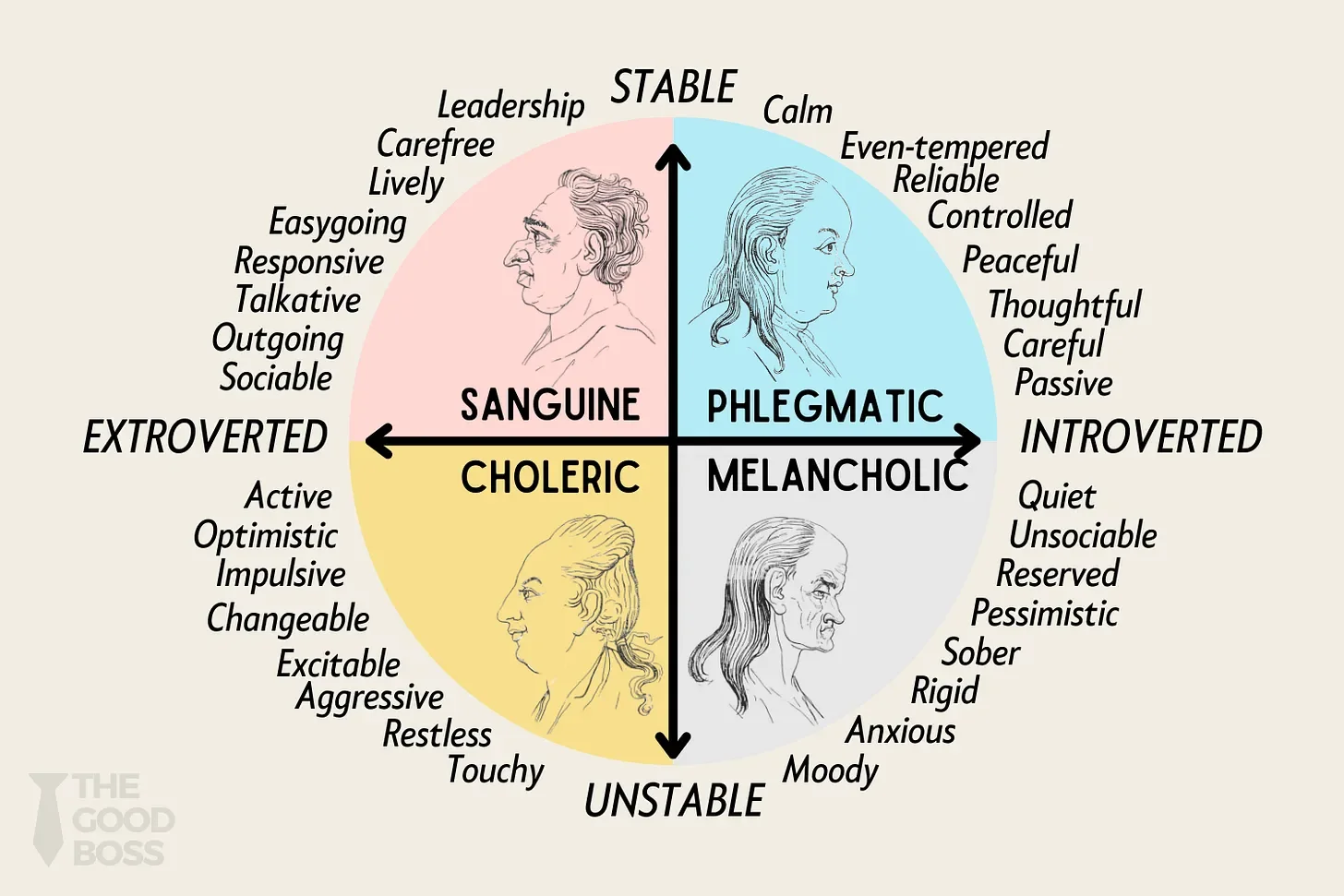
The Four Temperaments
Daily references to temperament abound- a person is described as extroverted, moody, sensitive, resilient, etc. We consider these traits as innate, although temperament can also be shaped by experience. As clinicians, we are (hopefully) constantly assessing and considering clients’ temperaments as we support their adaptability, receptivity, and functionality in everyday life.
I want to talk about temperament for a couple of reasons. One is that I often notice parents describing their child’s temperament, which is remarkable to me. While it seems rather second nature, especially as a mother myself, I also speak with many adult clients who describe their childhoods as if their own temperaments were not at all considered by their parents while growing up. This is their perception, of course, but it seems evident that parenting has evolved. Parents have more information and are paying a lot more attention to their kids. I know this is not rocket science; it’s just worth appreciating and acknowledging. Temperament is a wonderful tool with which to better see ourselves and perhaps our children, then allowing opportunities for accommodations, discussions, or deliberate challenges to strengthen or stretch our capabilities.
I have another, almost unrelated observation about temperament that has always helped me, and my students, understand the human condition:
Temperament defines a person’s mood, including their tendency towards positive emotions, negative emotions, both, or neither. Some people have lots of strong feelings, whereas other people are more neutral or distant from their emotions.
Then, temperament also determines how we tolerate these emotions. Some people have very strong emotions and are cool with that. They might tolerate or “enjoy” having a wide range of emotions, even if some are negative. Other people do not like strong feelings. They might experience deep distress or a sense of being thrown out of balance, even by feelings that would feel mild or insignificant to others.
As you might imagine, clinicans almost always work with people who have trouble tolerating emotions or perhaps are in relationships with others who wish they’d better manage these emotions. More specifically, we are often helping people navigate negative emotions, and maybe even redefine negative emotions as sensations and information that can not only be tolerated but studied and (sometimes, with great practice) mastered. And by mastered, I mean that we can welcome all emotions, learn from them, and determine the best actions based on this data. This is the work, and it’s especially hard work for certain temperaments.
For the record, here are the nine main components of temperament that research has identified (mostly attributed to Thomas and Chess):
Activity Level (baseline physical energy)
Regularity (predictability of everyday biological functions)
Initial Reaction (tendency to approach or withdraw to new people or in new situations)
Adaptability
Intensity (of emotional expressions)
Mood (general disposition)
Distractibility
Persistence/Attention Span
Sensory Threshold (sensitivity to sensory input)