How to Have Difficult Conversations
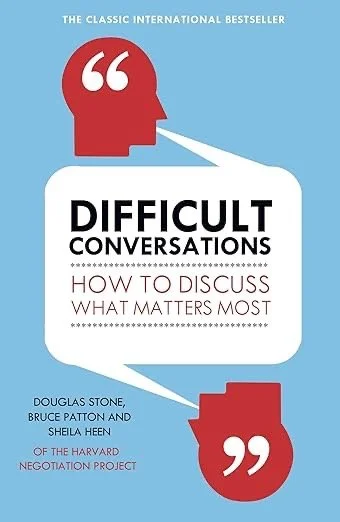
Authors Stone, Patton and Heen share culminated wisdom from the Harvard Negotiation Project
Almost no one enjoys a difficult conversation. Yet, in healthy relationships, they are unavoidable. Of course, conflict avoidance is rampant, and even the norm in so many professional and personal relationships. If only everyone was assigned the book Difficult Conversations, how much better these things might go. I have recently suggested it to a few clients, so I dove in for another re-read.
Yes, this book is 25 years old! But it remains so relevant that it’s twice been updated. It’s dense, broad, and chock full of insights and techniques. It might be best read when you’re at a crossroads in an important relationship or navigating an inevitable, difficult conversation.
The book invites us to consider what shapes the conflict we wish to solve: what actually happened/is happening, our feelings about it, and how our identity plays into it. We often make assumptions based on our feelings. Instead, the authors train us away from our own implicit rules and self-interests and toward a stance of curiosity; for example, questions that evolve from:
“How can they be so selfish?” to “I wonder what information they have that I don’t?”
“How can they be so irrational” to “How might they see the world such that their story makes sense?”
We must also stay curious about our own stories, what shapes us, and what we might not know about ourselves. Our identities come from so many aspects of our lives (e.g., race, gender, generational, chosen, conscious, imposed upon us). Defensiveness can arise when we let the other’s feedback define who we are. Stay grounded and curious while exploring identity. For example, recognize if you are a shifter (one who tends to place blame on others) or an absorber (one who assumes blame first).
Some quick tools that you might recognize or learn more about:
Adopt the “And Stance”: Both sides are allowed their own experience without canceling out the other’s.
Shift from blame to contribution: Blame is wasteful and hurtful; in fact, contribution occurs on both sides and looks forward, defining what can change to improve communication and connection in the future. Contribution can seem hard to own; perhaps think about it from the other’s perspective or from a third-party role, like a mediator. How would a disinterested observer or consultant describe all sides of this conflict?
Describe feelings: We tend to avoid strong emotions when having difficult conversations but learning to express emotion (safely and thoughtfully) is a key element that deepens meaning and allows us to understand each other. After enough introspection, describe your feelings and how they shape your position.
During difficult conversations:
Stay balanced and don’t try to control the other’s response or reaction.
Remember that their identity is also impacted. Raise identity issues explicitly. Be willing to ask for help when you need to learn more.
Double check that you’ve shifted your purpose from persuading them that you’re right to understanding why they see it differently. Learn about their position. Ask questions, stay curious. Remember that listening transforms the conversation. Listening helps them listen to you in return. Ultimately, it may even enhance your ability to influence them.
Ultimately, also know when to let go. Don’t have the conversation if the real conflict is actually your own identity crisis. If you’ve decided not to pursue a difficult conversation, here are some tips:
remember that we are not always responsible to fix situations
we and others have limitations
we can separate the issue from our own identity
we can let it go and still care about it
Overall, keep practicing self-awareness. We like to think of ourselves as good, loving, and competent people, yet everyone makes mistakes or can be misinterpreted. The sooner we understand ourselves and our contributions, the easier it is to tackle challenges in our relationships.
This might seem like pretty dry stuff that transforms into juicy wisdom in the right situations. Take care of your relationships; it’s worth it.