Ennea-what ?!?
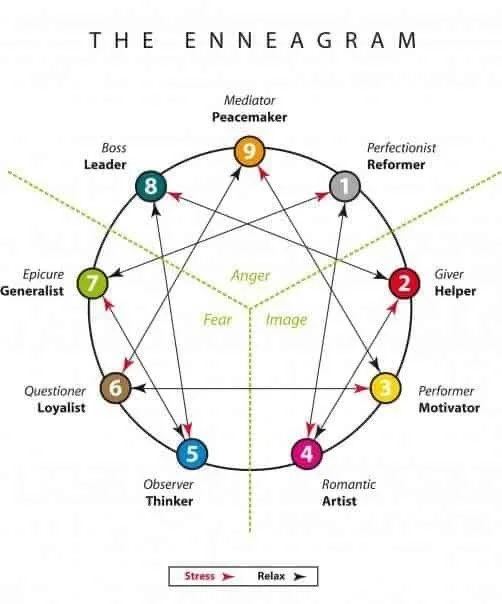
While the popularity of the Enneagram has only grown in recent years, I notice that in recent weeks it has positively popped off. I can barely turn on a podcast or watch a late-night show without someone bringing it up, needing to pronounce it a couple of times, explain its relevance, maybe try to guess the other person’s Enneagram type, you get the idea. So, we might as well get into it.
First, aren’t personality tests the coolest?! Fun fact: the only thing differentiating psychologists from any other licensed therapist, psychiatrist, etc. is that only psychologists can administer batteries of tests, including IQ tests and personality tests (nowadays, the internet or your TikTok algorithm can also administer personality tests, but I wouldn’t trust them if I were you). Once I got to grad school and discovered testing or “assessment” as we call it in the biz, I dove right in. I have always loved how quickly and cleverly we can learn about ourselves and our clients through pointed questions or even blots of ink.
The Enneagram consists of a series of questions that result in a dominant number (1-9) corresponding to a personality type. This might seem oversimplistic, but in a sea of personality tests, the Enneagram is special because:
There’s no single personality type, or number, that’s better or worse than another. In fact, each dominant number is balanced out by traits of another, as we move toward or away from versions of ourselves, such as during times of stress. What’s satisfying and effective for one person is totally different for another. By definition, the Enneagram is non-pathologizing.
It’s also a lot deeper than some other personality tests, like the Myers-Briggs. It’s not about our superficial, outward decisions but rather about internal motivations, passions, virtues, and pitfalls. It has roots in philosophy and the nature of existence, only eventually landing in the realm of psychology and personality traits. Some see it as an expression of spirituality or an articulation of an inner wisdom that resonates within all of us.
The Enneagram wheel is thoughtfully balanced and all encompassing. Each number is worthy of reverence, understanding, and respect. Fundamentally, it builds self-compassion as you learn more about why you think, feel and act in certain ways. You might discover the dominant numbers of friends or partners to inform how you interact and connect. It might even foster compassion toward people that tend to frustrate you, but only if they are willing participants! No armchair diagnosing.
Unlike most personality tests, for $20, you can take the Enneagram yourself, and get some pretty accessible and hopefully helpful feedback:
https://www.enneagraminstitute.com
But remember that most online personality tests are bogus, and even the Enneagram should only be interpreted along with other data points and perhaps even consultation with an expert :)
In fact, I have relatively limited knowledge of the Enneagram, although I may dig deeper (always banking those Continuing Education credits!)
Some of my knowledge comes from the OG Riso and Hudson books:
https://www.enneagraminstitute.com/store/
Further reading that delves more into spiritual realms (at your own risk!):
https://chrisheuertz.com/books/
https://openheartproject.com/the-buddhist-enneagram-nine-paths-to-warriorship/